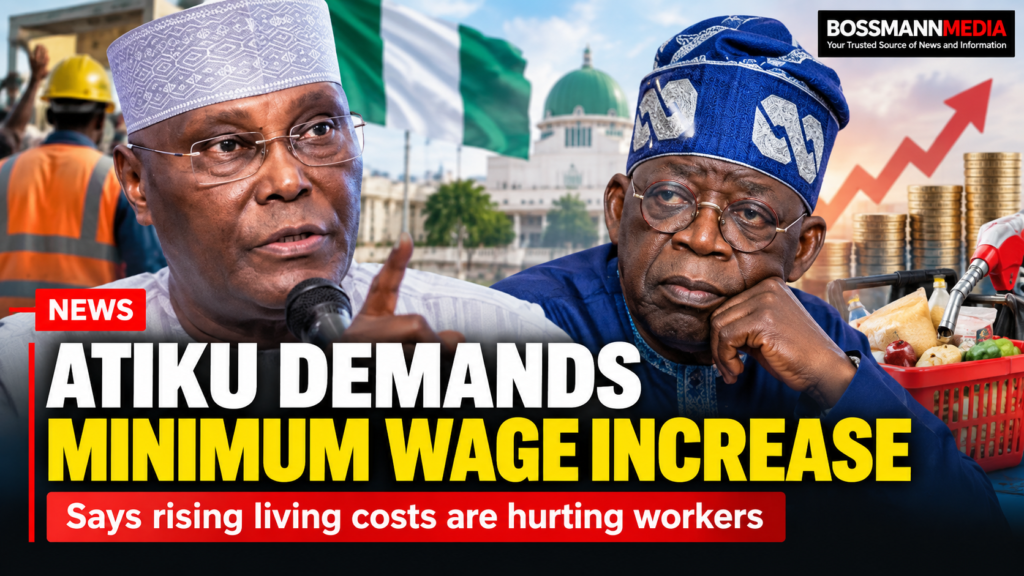
Former Vice President and African Democratic Congress (ADC) presidential candidate Atiku Abubakar has called on President Bola Tinubu to increase Nigeria’s ₦70,000 national minimum wage, arguing that rising costs of fuel, food, transportation and housing have reduced workers’ purchasing power.
Atiku made the call in a statement issued on Sunday by Phrank Shaibu, Director of Strategic Communications of the ADC Presidential Campaign Council.
He also criticised the Tinubu administration’s economic policies, particularly the removal of the petrol subsidy, which he argued had contributed to increased pressure on Nigerian households.
Atiku Says ₦70,000 Minimum Wage Has Lost Purchasing Power
According to Atiku, the current ₦70,000 minimum wage does not provide the same purchasing power that the previous ₦30,000 wage provided in 2023.
He used petrol prices as an illustration, saying that when petrol averaged about ₦254.06 per litre in April 2023, ₦30,000 could purchase approximately 118 litres.
At a petrol price of about ₦1,400 per litre, he said, ₦70,000 would purchase only about 50 litres.
“At ₦1,400 a litre, the entire ₦70,000 monthly minimum wage buys just 50 litres of petrol,” Atiku said, according to the statement.
He argued that the increase in nominal wages had not kept pace with the rising cost of living.
Minimum Wage Increased From ₦30,000 to ₦70,000
Nigeria’s national minimum wage was increased from ₦30,000 to ₦70,000 in July 2024 after negotiations involving the Federal Government, organised labour and other stakeholders. President Tinubu subsequently signed the amended minimum wage bill into law.
The law also provided for the minimum wage to be reviewed every three years.
Atiku, however, argued that the economic situation facing workers has changed significantly since the ₦70,000 figure was agreed.
He called on the Federal Government to begin discussions on another increase that would reflect prevailing costs of food, transportation, housing and other necessities.
Fuel Prices Add to Cost-of-Living Pressure
Atiku’s comments come amid renewed concerns over petrol prices in Nigeria.
Recent reports have put petrol prices at around ₦1,400 per litre in Lagos and Abuja, with prices reaching about ₦1,500 per litre in some parts of northern Nigeria. Reuters also reported that diesel prices had risen above ₦2,000 per litre amid renewed pressure from higher global oil prices.
The higher fuel prices have also intensified concerns about transportation and the cost of goods and services.
Atiku argued that increased petrol prices affect more than motorists because transportation and production costs can influence the prices of food and other essential commodities.
Atiku Promises Further Wage Action if Elected
The former vice president also outlined what he said would be his approach to wages and the cost of living if he wins the 2027 presidential election.
Atiku said he would begin work on raising the wage floor from his first day in office.
According to his statement, Atiku proposed a targeted production subsidy for petroleum products refined in Nigeria and sold to Nigerian consumers. He said such support would be subject to spending limits, public accounting and independent auditing.
Atiku Compares Nigeria’s Wage With Other Countries
Atiku also compared Nigeria’s minimum wage with wages in several African and oil-producing countries.
Using exchange rates cited in his statement as of July 24, 2026, he said the monthly minimum wages in Libya, Algeria, Equatorial Guinea and Gabon were worth approximately ₦213,000, ₦245,000, ₦302,000 and ₦351,000 respectively when converted to naira.
However, wage systems, prices and living costs differ between countries, making direct comparisons dependent on the exchange rates and cost-of-living measures used.
Wider Debate Over Workers’ Welfare
The latest demand comes amid continued debate among government, labour unions and political actors over workers’ purchasing power.
The Nigeria Labour Congress has also called for action over the rising cost of living and has raised concerns about the adequacy of the ₦70,000 minimum wage as prices increase.
The Federal Government’s position when the ₦70,000 minimum wage was introduced was that the figure followed negotiations with organised labour and other stakeholders, with a three-year review period incorporated into the arrangement.
Atiku’s latest comments therefore add a political dimension to the ongoing debate over wages, fuel prices and the wider cost of living ahead of the 2027 election.
Conclusion
Atiku has urged the Tinubu administration to increase the national minimum wage, arguing that rising living costs have reduced the purchasing power of Nigerian workers.
While the ₦70,000 minimum wage remains the statutory national minimum introduced in 2024, the adequacy of the wage amid changing prices remains a subject of debate involving government, labour unions, employers and political parties.
Atiku has said that, if elected, his administration would pursue higher wages alongside measures aimed at reducing the cost of essential goods and energy.
Source:
Sources: Channels Television, Punch Newspapers, Guardian Nigeria and Reuters.